KAAS: Self-hosted Markdown knowledge compiler for AI agents
KAAS (Knowledge as a Service) from Bybit Exchange turns scattered notes and transcripts into an AI-ready knowledge base for teams. It compiles documents into a searchable Markdown wiki, uses LLM-driven iterative retrieval instead of vector embeddings, and exposes that context via the Model Context Protocol so AI agents can query sources. Notable features include incremental compilation, Docker-based self-hosting, a web chat UI, and MCP endpoint support. It suits developers and researchers needing private, local-first AI-accessible documentation.
KAAS transforms scattered records into an AI-readable Markdown knowledge base
As a knowledge-base compiler the tool uses an LLM to turn meeting transcripts, personal notes, and technical documents into a queryable Markdown wiki. That wiki is intended for AI agents to read and reason over via the Model Context Protocol, making it possible to ask the system work-specific questions. Typical outcomes include extracting meeting decisions, surfacing technical procedures for onboarding, and assembling searchable project documentation for research or development teams. Inputs are plain-text documents and transcripts.
Replies include verifiable citations but accuracy depends on model and source quality
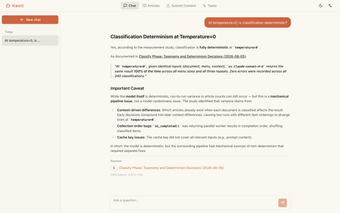
KAAS attaches citations to every chat reply that link back to the specific Markdown articles used to form an answer, allowing users to track sources and verify claims against original text. The system uses an LLM-iterative retrieval method rather than vector embeddings, which removes the need for an external vector store. That retrieval design narrows context selection, yet the final answer quality remains tied to the chosen LLM and the clarity of source documents; critical facts should be independently checked.
KAAS accepts transcripts, notes, and documents and compiles incrementally to limit reprocessing
The application processes meeting transcripts, notes, and technical files and converts them into Markdown pages. Incremental compilation only reprocesses new or changed documents, which reduces repeated LLM invocations for ongoing repositories. Because KAAS avoids embedding models, teams keep a file-based wiki rather than a separate vector database, simplifying storage and backup approaches for documentation-focused workflows. This design targets continuous documentation updates without constant full reindexing.
Deploying KAAS suits teams prepared to self-host and integrate with MCP clients
KAAS is built for self-hosted deployment using Docker containers across standard environments that support Docker. It acts as an MCP server and integrates with MCP-compatible clients such as Claude Desktop, Claude Code, and Cursor, enabling agents to query the compiled knowledge. The product includes a web UI for chat, content submission, and wiki management, which supports both interactive inspection and operational workflows alongside containerized deployments.
KAAS rewards teams that accept operational responsibility for their knowledge sources
KAAS is best for technically capable groups that can dedicate operational effort to curate documentation and maintain the system. Expect ongoing curation and independent fact-checking of generated replies. Practical practice: assign a documentation steward and enforce consistent Markdown structure before compilation to improve answer traceability. In short, KAAS delivers controlled, verifiable AI context when a team is willing to manage the necessary upkeep.